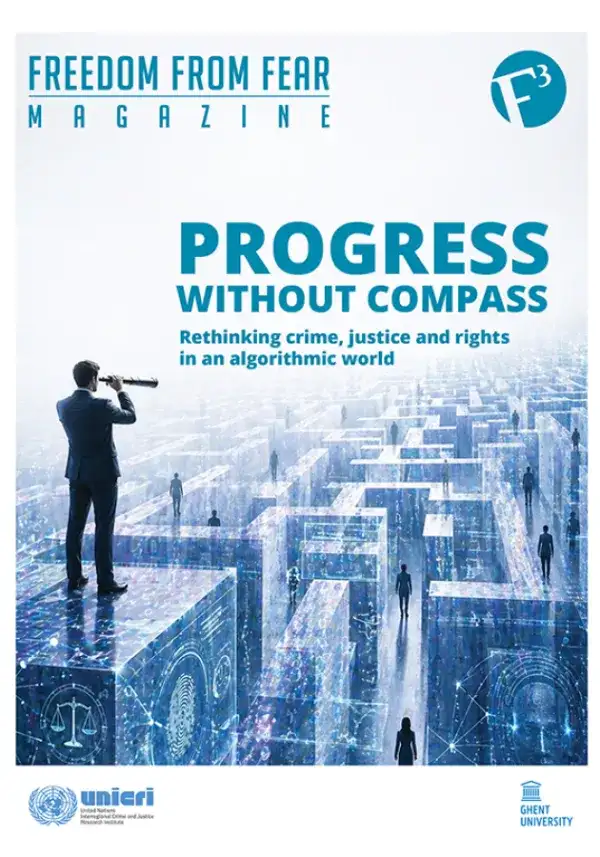
Progress Without Compass: Rethinking Crime, Justice and Rights in an Algorithmic World
The unprecedented speed of digital transformation is reshaping not only the way societies communicate, work, and access information, but also the way crime evolves, operates, and impacts individuals, institutions, and States. In a global context marked by growing geopolitical tensions, social fragmentation, and accelerating technological change, the opportunities created by innovation increasingly coexist with new vulnerabilities that are often difficult to identify, govern, and contain. As highlighted in the opening editorial by UNICRI Acting Director Leif Villadsen, the challenge of our time lies not solely in technological progress itself, but in the risk that such progress advances faster than our collective ability to understand it, regulate it, and guide it towards the common good.
It is within this evolving landscape that Progress Without Compass: Rethinking Crime, Justice and Rights in an Algorithmic World takes shape. This new edition of Freedom From Fear (F3) Magazine – an interdisciplinary publication dedicated to exploring contemporary challenges in the fields of security, justice, crime prevention, and human rights – examines the profound implications of technological transformation for societies worldwide.
This volume represents the second chapter in a broader editorial series dedicated to cybercrime, cybersecurity, and the impact of emerging technologies on global security. The first issue, The New Criminal Code: Deciphering Emerging Threats in Cyberspace, explored the rapidly evolving nature of digital threats and the transformation of criminal ecosystems in cyberspace. Building upon that reflection, Progress Without Compass expands the discussion further, placing at its centre the increasingly complex relationship between technological innovation, governance, fundamental rights, and societal resilience.
Bringing together contributions from international experts, institutional representatives, academics, practitioners, and young authors from different regions of the world, the magazine explores themes ranging from cyberpsychology and AI-enabled cybercrime to deepfakes, online fraud, digital radicalization, hybrid threats, and the evolving intersection between cybersecurity and international law. The publication also examines the growing importance of multilateral cooperation, public – private partnerships, Safety Tech, and human-centred approaches to strengthening digital resilience and safeguarding rights in an increasingly interconnected world.
Particular attention is devoted to the role of young people, who today stand simultaneously among the most exposed to online harms and among the most capable of shaping innovative responses to emerging digital threats. Several contributions emphasize the importance of investing in digital literacy, critical thinking, behavioural awareness, and youth engagement as strategic pillars for building safer, more inclusive, and more resilient digital societies.
Ultimately, Progress Without Compass invites readers to reflect on one of the defining questions of our era: how can technological progress be prevented from becoming a source of fragmentation, manipulation, and insecurity, and instead be guided towards justice, human dignity, and peace? As suggested in Villadsen’s editorial, the greatest risk is not simply moving too fast, but moving forward without a shared sense of direction. In a world increasingly shaped by algorithms, automation, and digital interdependence, building an ethical, legal, and human compass for progress is no longer optional – it is an urgent collective responsibility.
In this issue
- Editorial by Leif Villadsen
- Online harms affect youth: growing threats and integrated responses by Human Digital
- Tracking the unseen: measuring the financial impact of cybercrime by Seán Doyle and Giulia Moschetta
- The cyberpsychology of AI-enabled cybercrime: human factors, emerging threats, and building resilience by Mary Aiken
- Cybercrime in the Age of Artificial Intelligence (AI) by Marta Janus
- Overcoming the anonymity–trust dilemma by Rin Tsuboyama
- AI in cybersecurity: A double-edged sword by Annie Samira Kamga Ngatchou
- Emerging technologies and non state actors: A new emerging threat by Vibhuti Thapliyal
- How open knowledge in cyberspace fuels drone weaponization by Lara Maria Guedes Gonçalves Costa
- Law beyond borders: the UN Cybercrime Convention navigating legal challenges in cross-border digital threats by Vladimir Aras
- The hybrid threat of cyber-terrorist groups: critical gaps in the international legal framework by Matteo Pastorella
- The application of international humanitarian law to non-kinetic cyber operations by Mariam Salukvadze
- Justice by design: reimagining rights-based responses to cybercrime in Africa by Tina Power
- Digital rights and legal protection in unstable countries: An Iraqi youth view by Reman Mohammed
- Public–private partnerships as the scaffolding for safer digital spaces by Nagham El Karhili
- The links between terrorism and organized crime in Mali by Adama Mamadou Ballo, Ibrahim Ahmadou Dicko, Ibrahim Traore
- Gender dimensions and youth engagement in cybersecurity by Avnita Singh
- Cyber Sakhi: a digital safety friend for those left behind by Maanya Chauhan
- Beyond the binary: empowering youth as agents of change in cybersecurity and crime prevention by Per-Albin Johansson
- From village Wi-Fi to virtual battlefields: how rural youth are becoming cybersecurity’s frontline by Santhos Sivan
- Digital guardians of the AI era: building youth cybersecurity resilience by Ziarla Mae Malabanan
- Youth are at the heart of cyber resilience by Alessia Balsamo
- Cyber peace in cyberspace: empowering youth for the safe and fair use of technology by Princess Tudtud
- Strengthening digital resilience through youth empowerment: a global, youth-centered approach by Martina Matijević