The New Criminal Code: Deciphering Emerging Threats in Cyberspace - Freedom From Fear Magazine, January 2026
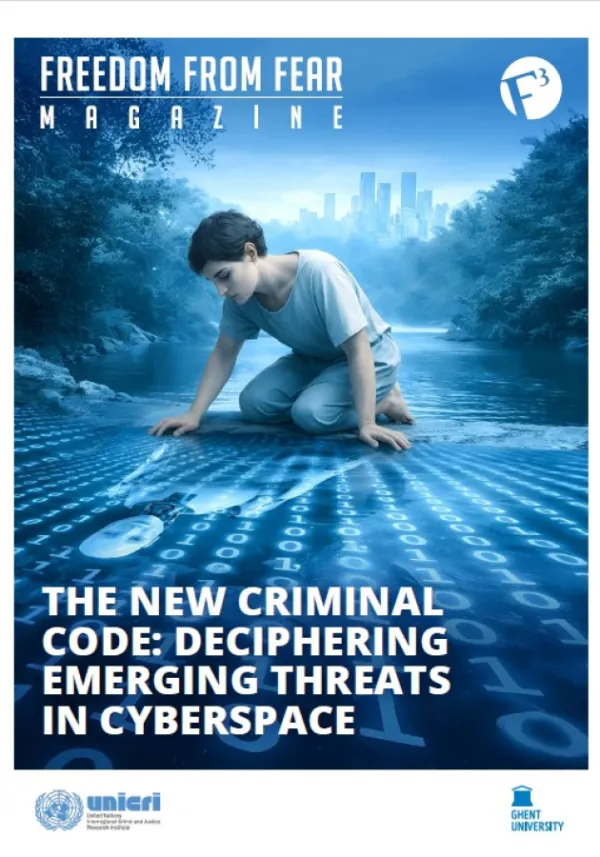
Cyberspace has become a defining arena for contemporary crime, conflict and security. As emerging technologies transform the way societies function, they are also reshaping how criminal actors operate, how conflicts unfold, and how legal and governance systems are challenged to respond. This new issue of Freedom From Fear Magazine (F3), The New Criminal Code: Deciphering Emerging Threats in Cyberspace, jointly produced by UNICRI and Ghent University, examines these dynamics through a multidisciplinary and forward-looking lens.
One of the themes explored in this issue is the growing role of artificial intelligence in both enabling and countering crime. Contributions examine what is currently known — and still unknown — about AI-enabled criminality, the risks associated with generative AI, and the emerging phenomenon of jailbreaking AI systems. Several articles also explore how these developments intersect with human rights, including the misuse of deepfakes, online child sexual exploitation and abuse, and the often-overlooked prosocial applications of new technologies.
The magazine further examines how digital technologies are being exploited in contexts of conflict and fragility. Articles address the use of digital tools by non-state armed groups, the manipulation of information in armed conflicts, and the evolving role of cyber warfare in shaping power, perception and peace. Particular attention is given to the dual-use nature of technologies such as satellite internet, which can simultaneously support development while generating new security challenges in fragile environments.
Another important area of analysis concerns the intersection between cybercrime and illicit economies. Contributions explore how criminal actors exploit blockchain-based finance, digital entertainment platforms and cyber tools to launder proceeds, steal trade secrets and extract resources. These analyses highlight persistent governance gaps and the need for stronger regulatory and enforcement responses across jurisdictions.
Several articles move beyond technology itself to examine human behaviour as a critical — and often underestimated — factor in cyber conflict. By focusing on decision-making, perception and manipulation, the issue underscores that technological threats cannot be addressed through technical solutions alone.
Finally, the magazine broadens the lens to consider resilience, peacebuilding and long-term stability. Case studies from the Sahel and other regions explore how communities respond to violence and extremism, how natural resources intersect with peace processes, and how justice and reintegration efforts can be strengthened in complex post-conflict settings.
Together, the contributions in this issue offer a nuanced and comprehensive exploration of the emerging “criminal code” of cyberspace. They highlight the urgent need for legal, policy and justice systems to adapt — not only to keep pace with technological change, but to ensure that security, human rights and the rule of law remain firmly anchored in an increasingly digital world.
Content
When code shapes crime: rethinking responsibility in the digital age by Leif Villadsen
AI crime: what we know, what we don’t know, and what we need to know by Marie-Helen (Maria) Maras
Breaking the machine: jailbreaking AI and safeguarding the digital frontlines of vulnerable communities by Fabien Leimgruber and Alexandru Lazar
The P3 equation: cyber warfare shaping peace, power and perception by Sarra Hannachi
Cyberterrorism: legal and governance challenges by Yéelen Marie Geairon
Using cyberweapons to steal trade secrets by Vasilis Katos, Kenneth Wright and John Zacharia